
Apply where
you qualify.
Every posting is screened against what your resume actually shows. You see the score, the gaps, and the reasoning.
- Indeed
- Glassdoor
- Adzuna
- Company sites

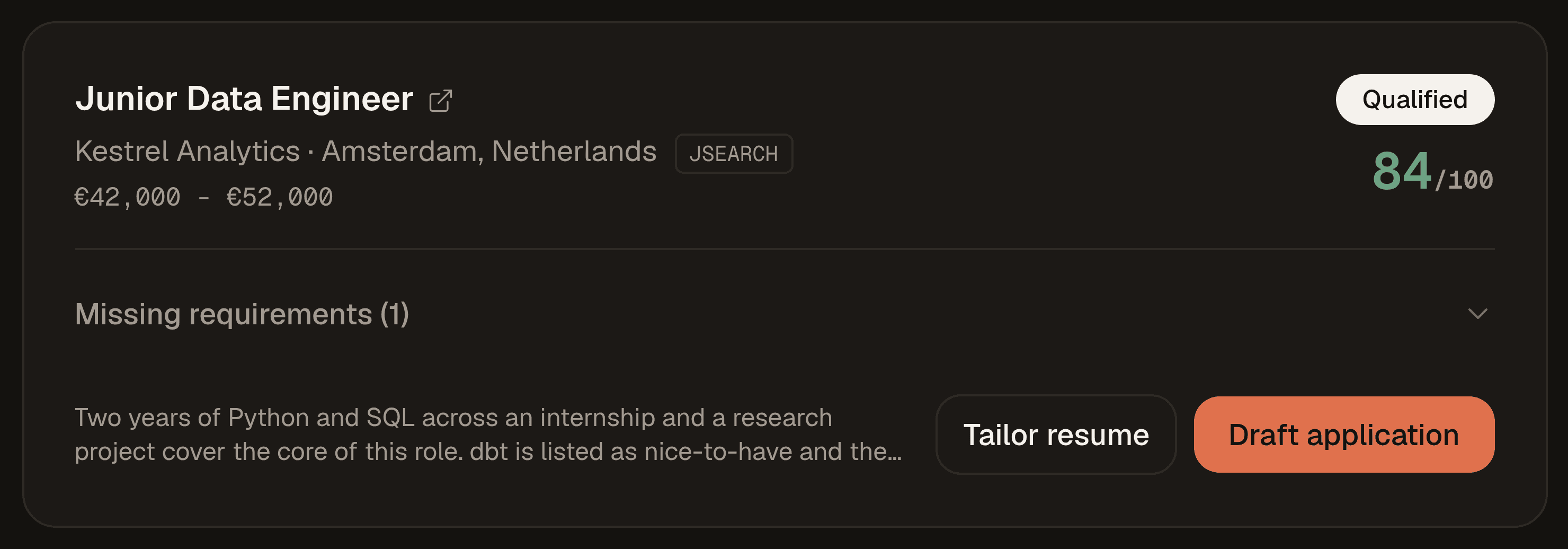
Most job hunts fail quietly.
You send two hundred applications and hear back from four. Nobody tells you which ones were never winnable, or why.
A number, and the reason behind it.
Claude reads the posting and writes down what it asks for. A fixed formula does the scoring. Drag the dial to see where the line sits.
- 70+
- Qualified. Worth your afternoon. A cover letter is drafted for you to edit.
- < 70
- Not yet. You get the specific gap instead of a rejection three weeks later.
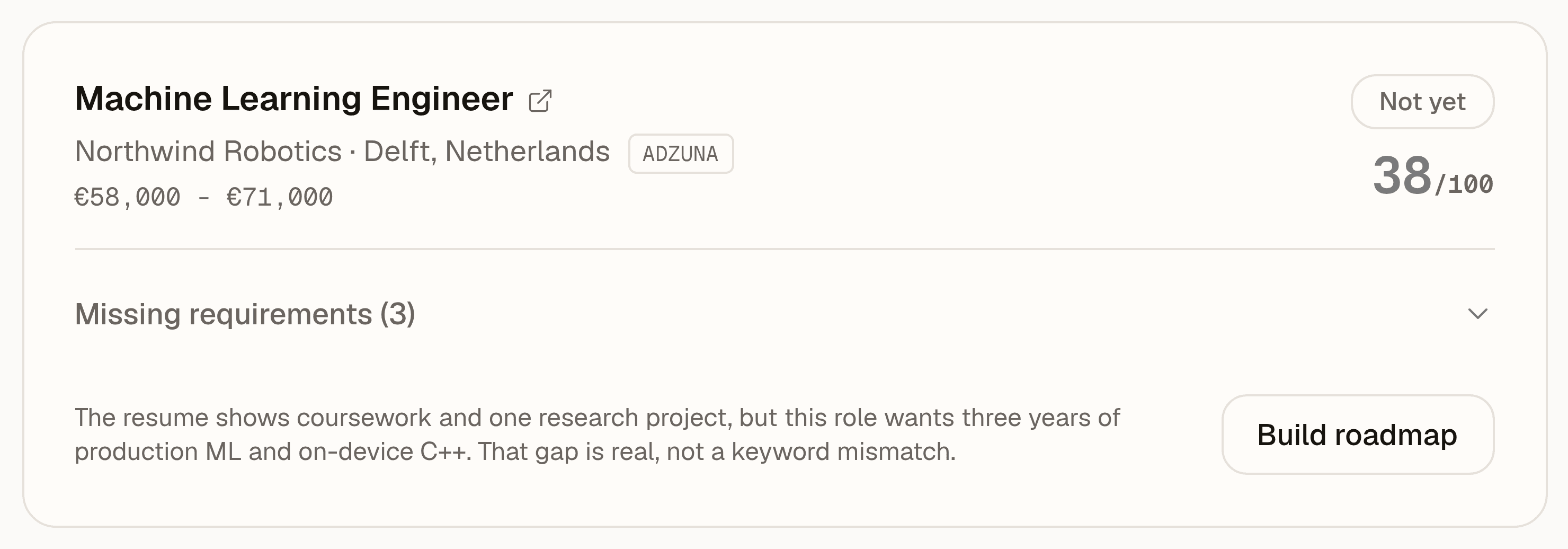

The model reads. The arithmetic decides.
Two numbers run this product, and neither is an opinion. Claude does what it is genuinely good at — reading a job advert, counting what is on a page — and then a fixed formula turns those facts into a score.
Match score
out of 100, for one jobHow well this posting lines up with what your resume actually shows.
Claude reads the posting — and only the posting. It never sees you while it works. It writes down what the advert asks for: the must-have skills, the years wanted, the seniority, where the work is, whether they sponsor a visa.
Your resume is already a profile in the same shape, with every skill matched against a catalogue of 332. React.js, ReactJS and React are one thing. A skill you used at work counts for more than one you only listed.
Six parts are then weighed against each other, required skills heaviest. Missing must-haves cost more than their share, because screening is all-or-nothing and the arithmetic follows it.
Four things stop it dead: no right to work somewhere nobody will sponsor, a missing licence, an onsite role in a country you will not move to, or an advert that has closed. Any one of them and the score is zero, with the reason named.
Every gap is priced by re-running the whole score with that skill added. “Spark: +10” means it genuinely came out ten points higher — not an estimate.
ATS score
out of 100, for your resumeWhether the software sitting between you and a human can read your CV at all.
Your PDF is opened twice. Once the way cheap screening software reads it — straight down the page, with no understanding of layout. Once properly, with the columns worked out and read in the right order.
What the careless read loses is the finding. If it drops your phone number, your Experience section or half your job history, that is not a guess about what an ATS might do. It is a record of what one just did.
The file itself is inspected too: columns, tables, text boxes, a photo, contact details stranded in the page header, skills drawn as rating bars instead of written out. None of that survives into plain text.
Then one model call, and it only counts. How many bullet points, how many carry a number, how many clichés, how many first-person pronouns. It is never asked whether your resume is any good.
The photo rule knows where you are applying: a photo costs you points in the US and nothing in the Netherlands, where it is the convention.
Because the last step is arithmetic rather than a judgement, the same resume and the same posting produce the same number every time — and every point of it can be accounted for.

How it runs
Upload
Drop in your resume. It gets read once and turned into a profile.
Match
Every posting is screened against that profile, not against keywords.
Apply
Qualified roles get a drafted letter. You read it, edit it, and send it yourself.
Close the gap
For the rest, a plan: the specific skills standing between you and a yes.

The rest of the application
Search is the start. Everything from the first resume review to the offer lives in the same loop.
Resume studio
A blunt review with the fixes spelled out, a live editor, and ten templates that typeset whatever you write into a PDF.
Tailored resumes
One click re-emphasises your real experience for a specific posting. Selection, never invention.
Paste any job
Found something elsewhere? Paste the posting and it runs through the same screen.
Tracker and follow-ups
Every application from submitted to offer, with a follow-up note when a company goes quiet.
Your funnel, measured
Qualification rate, response rate, and how your scores move as you close gaps.

Free while it is early.
These are the plans for when pricing starts. Everyone who signs up before then keeps Pro, free, permanently.
Free
€0forever
Enough to see whether it works for you.
Pro
€9.99/ month
billed €119.88 yearly
For an active search.
Unlimited
€14.99/ month
billed €179.88 yearly
Everything, at full speed.